|
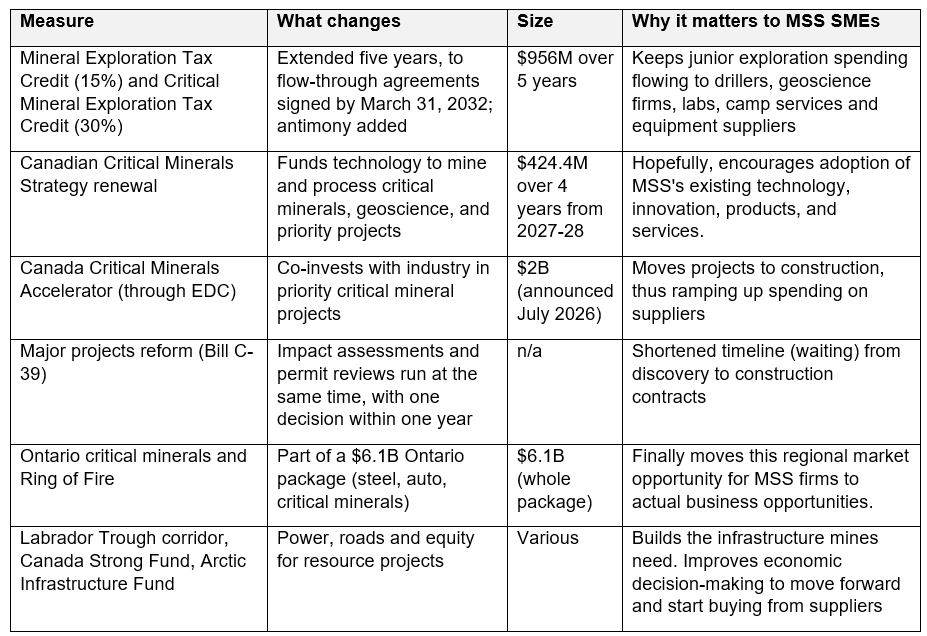
In our recent weekly member newsletter (Nov 10, 2026) we highlighted the federal budget from the mining industry perspective. Today, we wanted to look at it from a Mining Supply and Services (MSS) sector perspective which are made up specifically of small and medium enterprises (SMEs). Budget Analysis Unfortunately, Budget 2026 has no measure aimed specifically at mining supply and services (MSS) SMEs. Our sector benefits mostly indirectly: the budget puts more money into exploration and mine building, and general SME tax measures make it cheaper for MSS firms to invest. Below, is a table that summarizes the Demand-side measures: more spending by mining clients. The biggest effect on MSS firms comes from their customers with the assumption that more exploration money and faster mine construction mean more orders for suppliers. |
Direct support for MSS SMEs – A business perspective
The MSS sector SMEs have no special strategically recognized treatment and get the same tools as other SMEs. That said, several of these may fit the sector well.
- Productivity Mega Deduction: lets firms write off machinery, equipment and technology immediately, and the budget names mining equipment as eligible. It helps manufacturers, contractors buying rigs or fleets, and shops upgrading tools.
- SR&ED expansion: mining technology developers can now claim regulatory testing, certification, and patent costs, on top of the 35% enhanced credit for SMEs (on up to $6M of spending).
- Tariff supports: RTRI working capital (+$1.5B, nearly $3.5B in total), the BDC Pivot to Grow cash-flow stream ($500M, open from $1M in revenue) and the $2B Diversification Fund. The budget’s RTRI examples include $969K to a Northern Ontario firm developing mining technologies and $5.1M to a Saskatchewan partnership helping SMEs enter export markets.
- Export market access: deals were concluded with Indonesia, Ecuador and the UAE, and talks continue with ASEAN, India, Mercosur (including Brazil) and the Philippines. These are major mining markets outside the U.S.
- Export finance: a higher Canada Account limit at EDC, and the Canadian Commercial Corporation (which sells to foreign governments) becomes an EDC subsidiary. BDC and EDC will merge into one development bank covering firms from domestic growth through international expansion.
- Less paperwork: a $7,500 instalment threshold from 2028, a single May 15 filing date, and simpler federal procurement for SMEs.
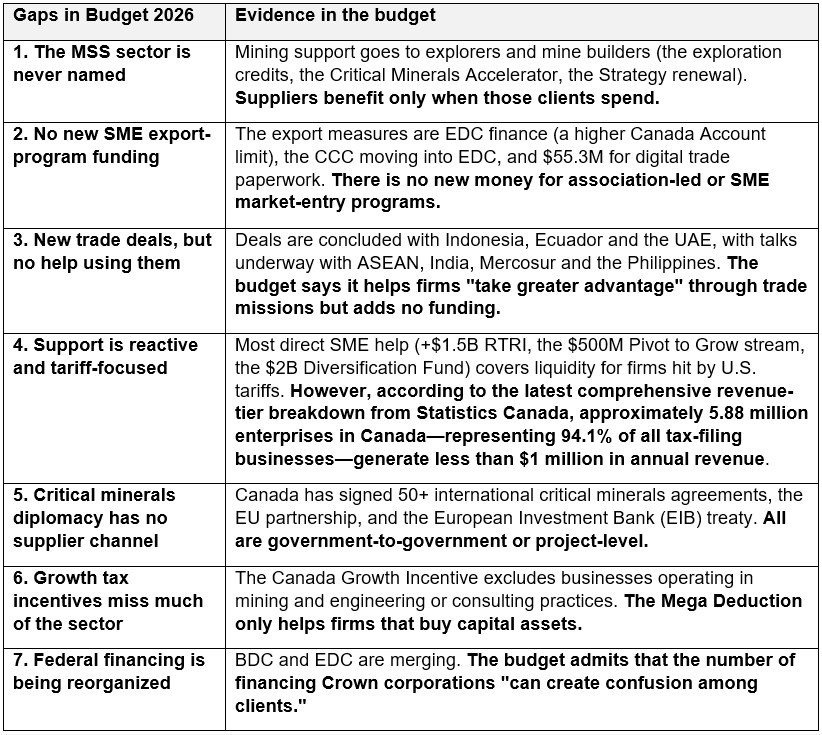
But MSTA CANADA has identified what we believe are major gaps in Budget 2026 that, as a result, do not properly support the MSS sector companies as highlighted in the following table.
The federal government needs to recognize the strategic importance of the Mining Supply and Services (MSS) sector. This recognition explicitly acknowledges is that nothing bets discovered, built or operates without the MSS sector and the recognition that the majority of MSS companies are SMEs – a specific group that has products and services for sale now and needs the appropriate assistance to grow, scale and be resilient.
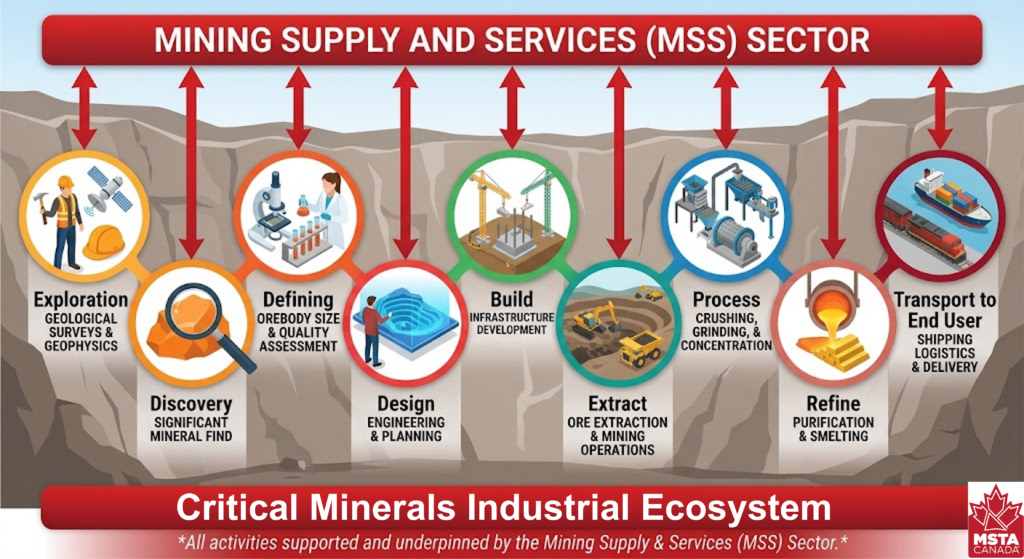
The attention to Critical Minerals around the world makes the MSS sector ripe for extraordinary growth. A clear sector to back by the federal government to in their ambition to double exports to non-USA markets in 10 years.
Then Canada will have a MSS sector with the capacity to deliver on the Critical Mineral objectives set out by the government of Canada. MSTA CANADA is the national organization to partner with to make this happen.