The ‘Hidden’ Foundation of Canada’s Critical Minerals Economy: The Mining Supply and Services (MSS) Sector
In Part 1: Geopolitics and the End of Efficiency: The Canadian Mandate for Global Resource Security, we discussed how global supply chains are shifting from cost-driven globalization toward resilience, regionalization, and trusted trade relationships following major geopolitical and systemic disruptions. As critical minerals, energy, semiconductors, batteries, and other strategic inputs become central to national security, Canada is uniquely positioned through its abundant resources, clean and reliable electricity, proximity to the U.S., global port access, and established industrial expertise. However, focusing primarily on exporting raw materials risks repeating Canada’s historical role as a resource supplier. The greater opportunity is to develop vertically integrated, resilient North American supply chains that capture value across extraction, processing, manufacturing, and advanced industrial applications. This is now Part 2 of our op-ed series.
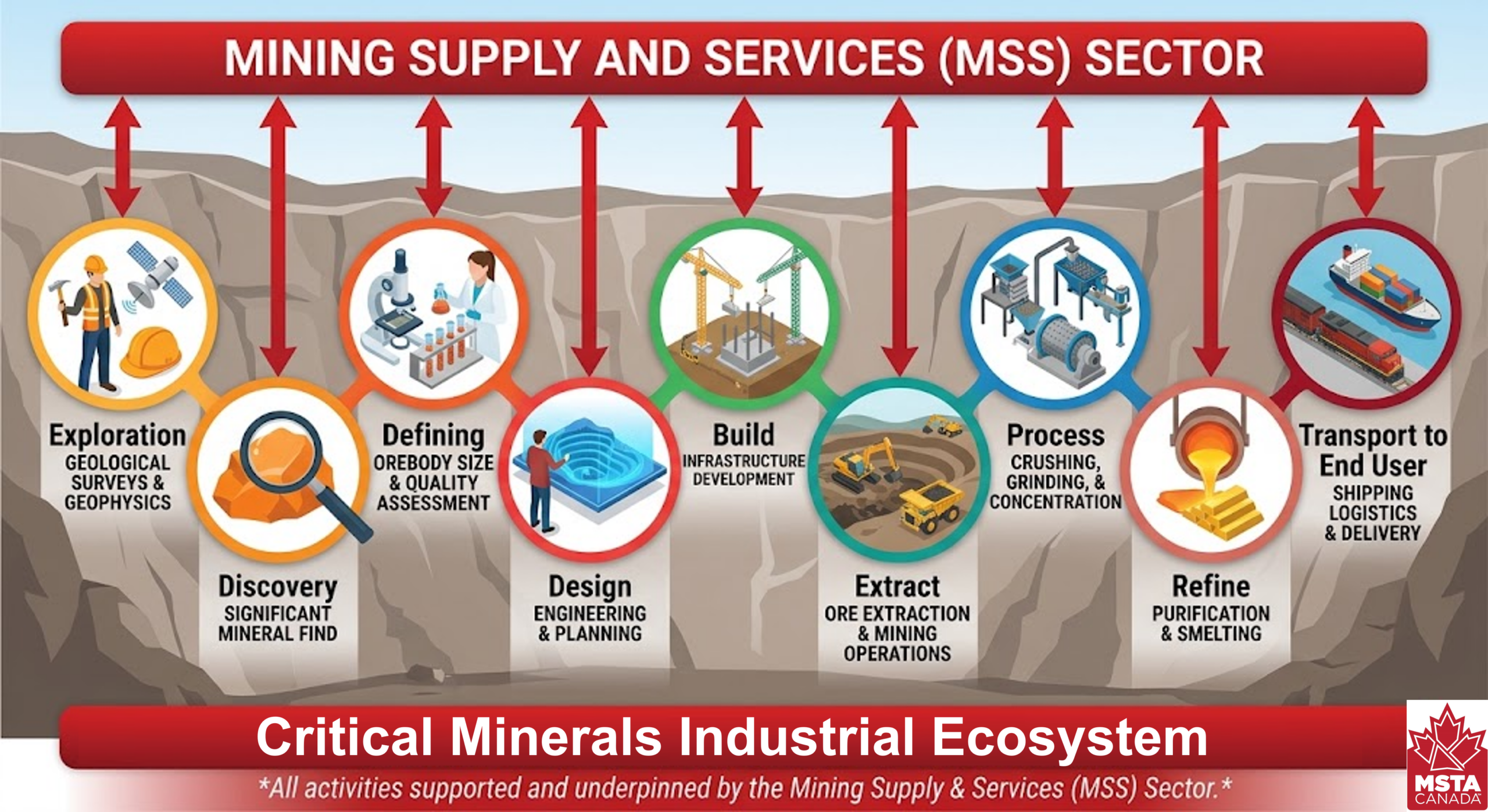
The conventional economic definition of the critical-minerals industry is fundamentally flawed and too narrow in its view. In the public eye and within fiscal policy frameworks, the industry is often treated as though it begins the day a mine commences production. In reality, the critical-minerals economy begins ten to fifteen years earlier. It is anchored not by the mining operators themselves, but by the highly specialized Mining Supply and Services (MSS) sector that provides the innovative solutions to explore, discover, define, design, build and operate the physical and digital infrastructure required to extract every single tonne of ore. Many also forget that the MSS sector includes the capital markets, the legal and accounting expertise that support a mine to become a reality.
Today, a modern, sustainable operating mine is far more than an extraction site—it is a complex, highly sophisticated, capital-intensive industrial facility that can operate like a small city in a remote location. Developing these projects requires a massive, multi-disciplinary network of business-to-business suppliers, contractors, professional services firms, technology providers, and infrastructure specialists, all working together to deliver one integrated operation.
The complex ecosystem begins long before production, with community consultations, permitting, geophysical and geochemical surveys provided by exploration contractors, who use advanced exploration technologies such as satellite imagery and aerial drones, drilling technologies, analytical and assay laboratories, geological modeling using artificial intelligence, environmental and archeology consulting, and health and safety management. As a project moves toward development, it requires detailed engineering, procurement, site preparation, earthworks, heavy civil construction, road building, structural fabrication, electrical systems, communications infrastructure, and specialized power-generation and distribution systems.
In many respects, developing a mine is similar to developing a city. A remote mining operation may require extensive transportation infrastructure, robust telecommunications and data networks, custom power systems, water supply and treatment facilities, complex water management and remediation systems, warehouses, workshops, fuel storage, waste-management systems, and heavy equipment and fabrication capabilities. These facilities must be designed and built to withstand demanding environmental conditions while meeting increasingly rigorous environmental, social, health, and safety requirements.
Once operational, mines depend on an equally diverse network of specialized suppliers. Operations require mining and fleet-management software, automation and control systems, industrial networks, sensors, communications equipment, high-pressure pumps, compressors, electrical and mechanical systems, explosives and blasting services, maintenance and repair capabilities, spare parts, tires and consumables, laboratory services, transportation and logistics, and specialized legal, accounting, insurance, financial, and human-resource services.
The more remote the operation, the broader the supporting ecosystem becomes. A mine may require employee housing, camps, kitchens and mess halls, laundry facilities, recreational and fitness facilities, medical clinics or hospitals and nursing stations, emergency-response services, aviation support, aircraft runways, marine infrastructure and seaports, road construction and maintenance, fuel and supply logistics, and even dedicated power and water utilities. All of these services must function reliably, often thousands of kilometres from major population centres, and frequently under extreme climatic and geographic conditions.
What makes mining particularly distinctive is the sheer breadth and specialization of this supplier network. A single mining company can become the anchor customer for hundreds or even thousands of businesses. The result is a highly interconnected industrial ecosystem in which a remarkably diverse range of suppliers and service providers collectively enable one customer—the mining company—to responsibly discover, develop, build, operate, maintain, and ultimately close and reclaim a modern mine.
Mining, therefore, is not simply an industry that extracts minerals. It is an industrial platform that creates demand across an extraordinary range of businesses, technologies, professions, and infrastructure. The complexity of a modern mine is reflected not only in the size of the operation itself, but in the vast and sophisticated mining supply and services (MSS) sector network required to make it possible.
As shown, the MSS sector represents the essential foundation of Canada’s resource economy, yet they consistently receive far less strategic attention and capital allocation than the mineral deposits themselves. Government industrial policies frequently fall into a binary trap: they offer modest tax incentives for early-stage exploration or financial packages to mining companies on one end, and orchestrate multi-billion-dollar subsidies for downstream battery cell gigafactories on the other. Left stranded in the middle is the specialized MSS sector: the very companies that build the autonomous systems, advanced powertrains, and specialized equipment needed to safely and sustainably operate a modern mine.
And it starts with how governments define the critical mineral supply chain – from the mine gate to the end user of finished goods. This policy blind spot misses a massive economic multiplier effect. When an industrial strategy focuses exclusively on mineral output, the economic benefit is bound to the volatile cyclical pricing of global commodities. Conversely, if domestic policy incentivizes Canadian MSS sector companies to become the preferred providers of products and services to domestic mines, it establishes a highly resilient home market.
As the domestic MSS sector companies scale up via local capital projects, they insulate local mining operations from global supply chain disruptions and reduce the structural backlogs that currently plague resource development. Once these technologies are proven domestically, these companies can then export their high-margin capabilities, technical services, and industrial equipment to mining operations worldwide. Almost every country across the globe is looking to aggressively develop its own mineral resources, and there lies an export diversification strategy waiting to be supported properly.
The mine, therefore, should not be viewed as an isolated economic endpoint. It must be treated as the anchor customer for a permanent, high-value industrial ecosystem. Because critical-minerals projects require tremendous capital and decades of development, the primary economic windfall for Canada is not just the eventual volume of commodities produced; it is the robust industrial capacity built along the way, and it’s called the Mining Supply and Services (MSS) sector.
This is part of an op-ed series by the Mining Suppliers Trade Association Canada (MSTA CANADA) that discusses Canada’s opportunity as an economic superpower in the context of critical minerals. Ryan McEachern is the Managing Director of the Mining Suppliers Trade Association Canada.