From a Dual-Use to a Three-Prong Industrial Strategy: Why Ontario Should Build an Automotive-Defence-Mining Advanced Manufacturing Ecosystem
In Part 2, The ‘Hidden’ Foundation of Canada’s Critical Minerals Economy: The Mining Supply and Services (MSS) Sector, we argued that Canada’s critical-minerals strategy must recognize that the industry begins long before a mine opens. The specialized Mining Supply and Services (MSS) sector provides the products and expertise required to explore, discover, define, design, build, and operate modern mines, yet receives far less policy attention and investment support than mining and downstream manufacturing. Supporting Canadian MSS companies through domestic mining projects would create a resilient home market, strengthen supply-chain security, accelerate mine development, and enable these firms to export high-value technologies, equipment, and expertise globally (refer to Part 1, The New Geopolitics of Supply: Canada’s Strategic Pivot From Resource Exporter to Global Mining Supply Powerhouse). Mines should therefore be viewed not as economic starting points, but as anchor customers for a permanent, high-value industrial ecosystem. In Ontario, this ecosystem can be expanded further through an Automotive–Defence–Mining Advanced Manufacturing Ecosystem.
Ontario is at an industrial crossroads. For decades, the province’s economic strategy has been anchored by automotive manufacturing. That industry remains enormously important, with roughly 148,000 Ontarians working in the vehicle, trailer and parts manufacturing industry in 2025. But the sector is entering a period of structural uncertainty as production shifts toward electric vehicles, supply chains are disrupted by tariffs, and manufacturers reassess where North American production should be located. As a result, the federal Job Bank expects employment in Ontario’s automotive manufacturing sector to weaken over the 2025–2027 period.
Enter the Defence Sector. The federal government and Ontario have identified how the automotive sector can benefit by integrating into the defence sector. Both levels of government have unveiled Defence Industrial Strategies that explicitly provide funding initiatives for retooling factories, reskilling workers, and helping businesses move into defence and dual-use production.
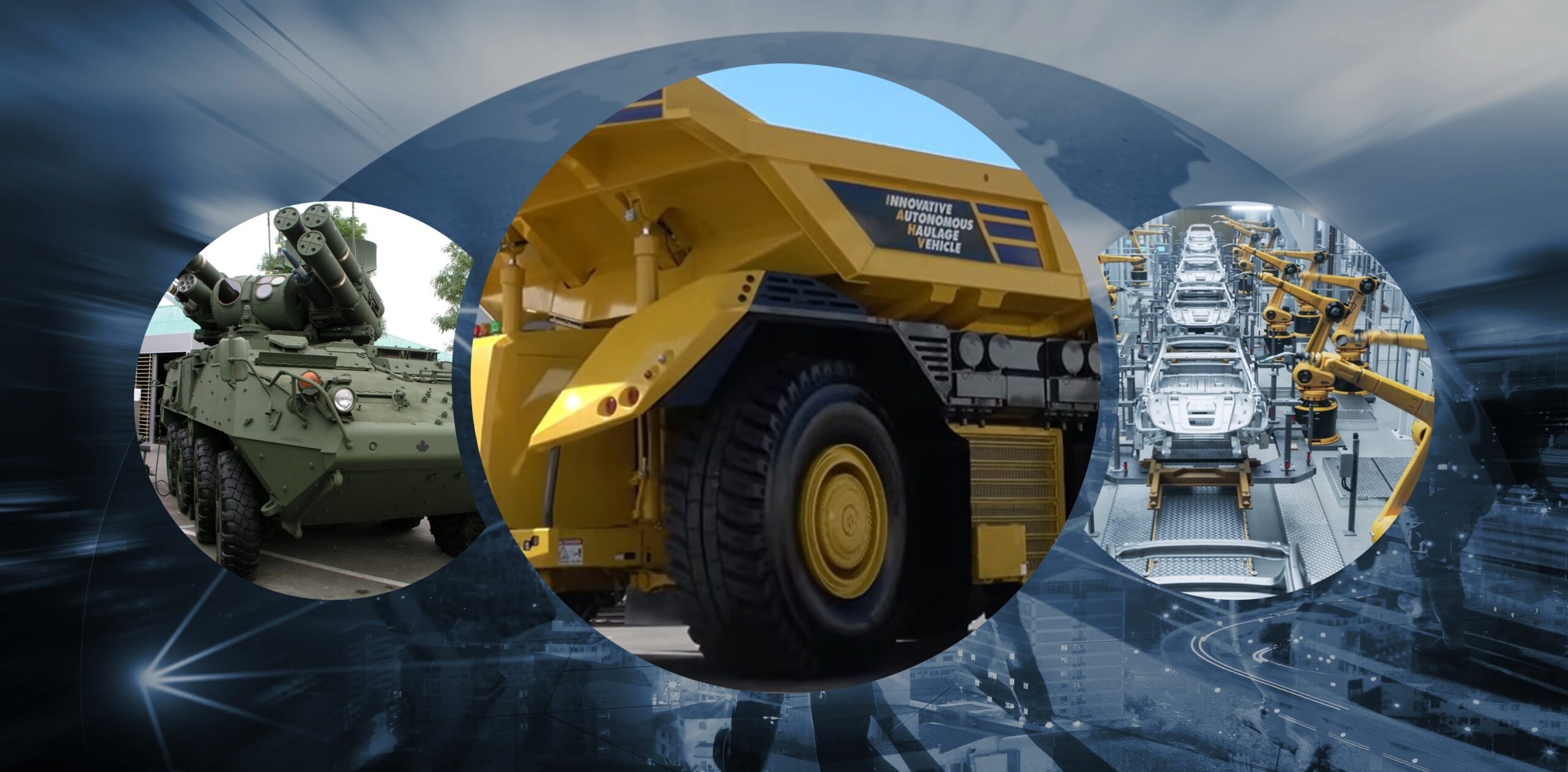
And it makes sense; Ontario’s automotive and defence sectors have significant opportunities for collaboration and shared growth. Commercial vehicle platforms, chassis, powertrains and manufacturing processes can be adapted for military vehicles, with GM Defense’s work in Ontario providing an example of this potential.
Similarly, automotive advancements in EV and battery technology—including batteries, electric drivetrains, thermal management and power electronics—can support defence applications, particularly autonomous and hybrid military platforms. Ontario’s advanced manufacturing base, including Tier 1–3 automotive suppliers, CNC machining, tooling, robotics and automation capabilities, can also support defence programs without requiring entirely new industrial capacity.
In addition, expertise in artificial intelligence, connected and autonomous vehicles, sensing, navigation, cybersecurity and software can be transferred into autonomous military vehicles and other defence systems. Finally, the highly skilled workforce shared across both sectors—including engineers, machinists, toolmakers, automation specialists and technicians—provides a strong foundation for expanding Ontario’s industrial capacity across both automotive and defence markets.
But there is a third economic pillar missing – the mining sector
Both the federal and Ontario governments have established strategies for developing critical minerals, and Ontario’s critical-minerals ecosystem further strengthens the above synergies by supporting both battery production and defence manufacturing and creating opportunities for more integrated domestic supply chains.
But the focus is downstream from extraction to end users (see Part 2, The Upstream Multiplier: Redefining the Critical-Minerals Industrial Ecosystem). Ontario has the opportunity to actually build a 3 Prong Manufacturing Strategy where automotive, defence and mining reinforce one another.
Ontario already has the foundation
The strongest argument for this strategy is that Ontario does not need to invent an industrial ecosystem from scratch. The province already possesses one of North America’s deepest automotive supply chains. It also has a sophisticated defence industry and a well-developed mining ecosystem; however, hidden is the untapped potential of the mining supply and services (MSS) sector value chain, comprising globally competitive engineering and manufacturing firms with demanding technical requirements.
The automotive industry has developed sector-transferable capabilities in electric powertrains, battery systems, lightweight structures, autonomous driving, sensors, software, robotics, quality control and high-volume manufacturing. Defence needs many of the same underlying capabilities, including drone applications, although with different specifications, certification, and operating environments. Mining needs them too.
The next generation of mines will require electric underground vehicles, autonomous equipment, remote operation, drone applications, advanced sensors, digital fleet management, robotics and increasingly sophisticated mineral-processing systems.
The objective isn’t to make a mining-equipment company into an automotive company or an automotive company into a defence contractor. It’s to create an environment where the same Ontario industrial capabilities can serve three markets. That gives manufacturers multiple sources of demand and gives Ontario a more resilient industrial base.
The integration leverages the province’s existing capabilities in engineering, vehicle and battery manufacturing, precision machining, robotics and automation, drone assembly and applications, sensors, autonomous and AI programming, and associated skilled trades to create a broader industrial ecosystem capable of serving three strategic markets. An Ontario company could develop an electric drivetrain that could subsequently be adapted for a mine vehicle, a commercial vehicle and a military vehicle using Ontario-produced nickel, copper, lithium, aluminum and other materials.
This is a much deeper economic integration than simply saying “Ontario has mines and car factories and builds armored vehicles”. That is a much bigger opportunity than any one of them alone, and the synergies are there. Automotive. Defence. Mining.
That is a 3-pronged advanced manufacturing strategy worthy of the next decade.
This is part of an op-ed series by the Mining Suppliers Trade Association Canada (MSTA CANADA) that discusses Canada’s opportunity as an economic superpower in the context of critical minerals. Ryan McEachern is the Managing Director of the Mining Suppliers Trade Association Canada.